Summary: Having surveyed and critiqued the political structure of Europe in Chapter I, Barlow turns next to the question of religion, offering a criticism of organized religion in general and the institution of the Roman Catholic Church in particular. His observations and rhetoric give a good idea of what views Enlightenment thinkers held towards organized religion, which emphasized religion’s propensity for sectarian or factionalist violence and intolerance.
Page 37
But it would have been impossible for the feudal system, with all its powers of inversion, to have held human nature so long debased, without the aid of an agent more powerful than an arm of flesh, and without assailing the mind with other weapons than those which are furnished from its temporal concerns. Mankind are by nature religious; the governors of nations, or those persons who contrive to live upon the labors of their fellow-creatures, must necessarily be few, in comparison to those who bear the burthens of the whole; their object therefore is to dupe the community at large, to conceal the strength of the many, and magnify that of the few. An open arrangement of forces, whether physical or moral, must be artfully avoided; for men, however ignorant, are as naturally disposed to calculation, as they are to religion; they perceive as readily that an hundred soldiers can destroy the captain they have made, as that thunder and lightning can destroy a man. Recourse must therefore be had to mysteries and invisibilities; an engine must be forged out of the religion of human nature, and erected on its credulity, to play upon and extinguish the light of reason, which was placed in the mind as a caution to the one and a kind companion to the other.
Page 38
This engine, in all ages of the world, has been the Church. It has varied its appellation, at different periods and in different countries, according to the circumstances of nations; but has never changed its character; and it is difficult to say, under which of its names it has done the most mischief, and exterminated the greatest number of the human race. Were it not for the danger of being milled by the want of information, we should readily determine, that under the assumption of Christianity it has committed greater ravages than under any other of its dreadful denominations.[1]
Page 39
But we must not be hasty in deciding this question; as, during the last fifteen centuries, in which we are able to trace with compassionate indignation the frenzy of our ancestors, and contemplate the wandering demon of carnage, conducted by the cross of the West, the lights of history fail us with regard to the rest of the world—we cannot travel with the crescent of the East, in its unmeasurable devastations from the Euxine[2] to the Ganges[3]; nor tell by what other incantations mankind have been inflamed with the lust of slaughter, from thence to the north of Siberia or to the south of Africa.
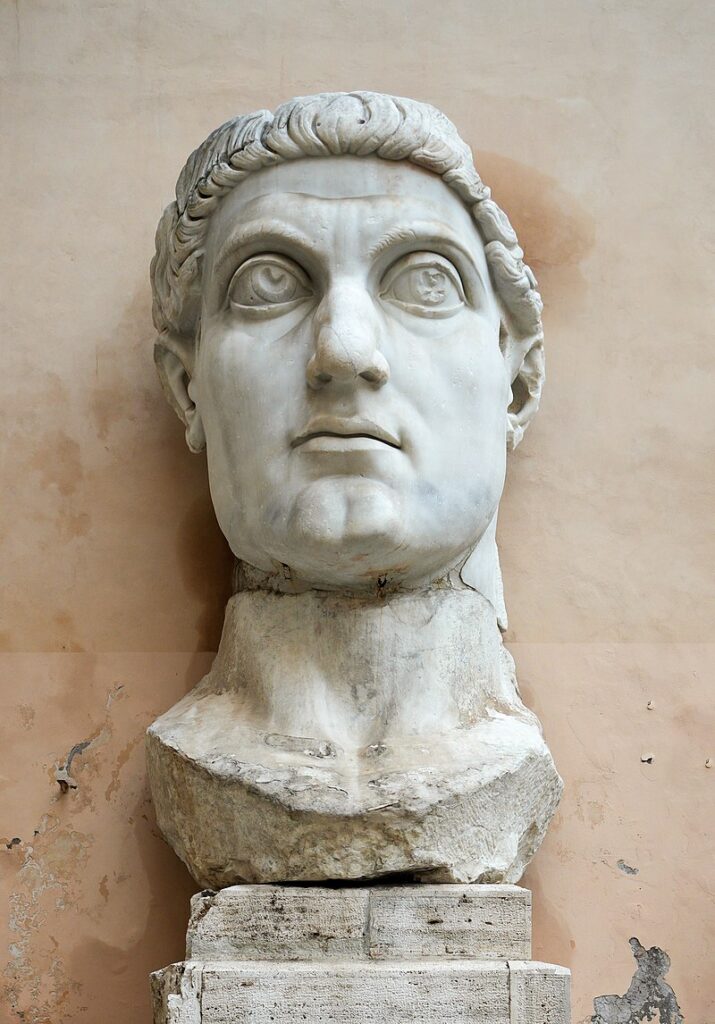
Could we form an estimate of the lives lost in the wars and persecutions of the Christian Church alone, it must be nearly equal to the number of souls now existing in Europe. But it is perhaps in mercy to mankind, that we are not able to calculate, with any accuracy, even this portion of human calamities. When Constantine[4] ordered that the hierarchy should assume the name of Christ, we are not to consider him as forming a new weapon of destruction; he only changed a name, which had grown into disrepute, and would serve the purpose no longer, for one that was gaining an extensive reputation; it being built on a faith that was likely to meet the assent of a considerable portion of mankind.
Page 40
The cold-hearted cruelty of that monarch’s character, and his embracing the new doctrines with a temper hardened in the slaughter of his relations, were omens unfavorable to the future complexion of the hierarchy; though he had just coupled it with a name that had hitherto been remarkable for its mildness and humiliation. This transaction has therefore given colour to a scene of enormities, which may be regarded as nothing more than the genuine offspring of the alliance of Church and State.
Page 41
This fatal deviation from the principles of the first founder of the faith, who declared that his kingdom was not of this world, has deluged Europe in blood for a long succession of ages, and carried occasional ravages into all the other quarters of the globe. The pretense of extirpating the idolatries of ancient establishments and the innumerable heresies of the new, has been the never-failing argument of princes as well as pontiffs, from the wars of Constantine, down to the pitiful, still-borne rebellion of Calonne and the Count d’Artois.
From the time of the conversion of Clovis,[7] through all the Merovingian[8] race, France and Germany groaned under the fury of ecclesiastical monsters, hunting down the Druids,[9] overturning the temples of the Roman Polytheists, and drenching the plains with the blood of Arians[10]. The wars of Charlemagne[11] against the Saxons, the Huns, the Lombards and the Moors, which desolated Europe for forty years, had for their principal object the extending and purifying of the Christian faith.
Page 42
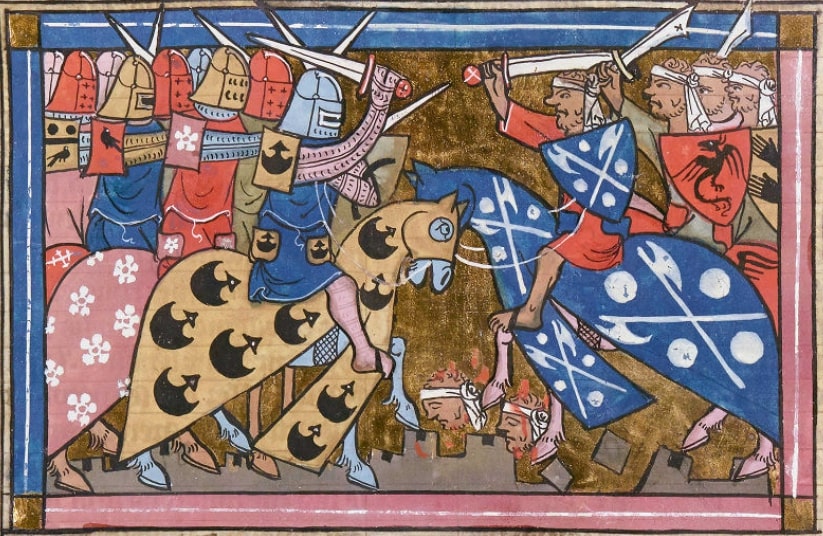
The Crusades[12], which drained Europe of its young men at eight successive periods, must have sacrificed, including Asiatics and Africans, at least four millions of lives. The wars of the Guelfs and Gibelins[13], or Pope and Anti-Pope, ravaged Italy, and involved half Europe in factions for two centuries together. The expulsion of the Moors from Spain depopulated that kingdom by a war of seven hundred years, and established the Inquisition to interdict the resurrection of society; while millions of the natives of South America have been destroyed by attempting to convert them.
In this enumeration, we have taken no notice of that train of calamities which attended the reconversion of the eastern empire, and attaching it to the faith of Mahomet[14]; nor of the various havoc which followed the dismemberment of the catholic church by that fortunate schism, which by some is denominated the Lutheran heresy, and by others the Protestant reformation.
Page 43
But these, it will be said, are only general traits of uncivilized-character, which we all contemplate with horror, and which, among enlightened nations, there can be no danger of being renewed. It is true, that in several countries, the glooms of intolerance seem to be pierced by the rays of philosophy; and we may soon expect to see Europe universally disclaiming the right of one man to interfere in the religion of another. We may remark however, first, that this is far from being the case at this moment; and secondly, that it is a blessing which never can originate
from any state-establishment of religion. For proofs of the former, we need not penetrate into Spain or Italy, nor recall the history of the late fanatical management of the war in Brabant[15], but look to the two most enlightened countries in Europe; see the riots at Birmingham, and the conduct of the refractory priests in France.
With regard to the second remark,—we may as well own the truth at first as at last, and have sense this year as the next: The existence of any kind of liberty is incompatible with the existence of any kind of church. By liberty I mean the enjoyment of equal rights, and by church I mean any mode of worship declared to be national, or declared to have any preference in the eye of the law.
To render this truth a little more familiar to the mind of any reader who shall find him|self startled with it, we will take a view of the church in a different light from what we have yet considered it. We have noticed hitherto only its most striking characteristics, in which it appears like a giant, stalking over society, and wielding the sword of slaughter; but it likewise performs the office of silent disease and of unperceived decay; where we may contemplate it as a canker, corroding the vitals of the moral world, and debasing all that is noble in man.
Page 44
If I mention some traits which are rather peculiar to the Roman Catholic constitution, it is because that is the predominant church in those parts of Europe, where revolutions are soonest expected; and not because it is any worse or any better than any other that ever has or ever can exist. I hinted before, and it may not be amiss to repeat, that the hierarchy is every where the same, so far as the circumstances of society will permit; for it borrows and lends, and interchanges its features in some measure with the age and nation with which it has to deal, without ever losing sight of its object. It is every where the same engine of state; and whether it be guided by a Lama[16] or a Musti[17], by a Pontifex[18] or a Pope[19], by a Bramin[20] a Bishop[21] or a Druid[22], it is entitled to an equal share of respect.
The first great object of the priest is to establish a belief in the minds of the people, that he himself is possessed of supernatural powers; and the church at all times has made its way in the world, in proportion as the priest has succeeded in this particular. This is the foundation of every thing—the life and soul of all that is subversive and unaccountable in human affairs; it is introducing a new element into society; it is the rudder under the water, steering the ship almost directly contrary to the wind that gives it motion.
Page 45
A belief in the supernatural powers of the priest has been inspired by means, which in different nations have been known by different names, such as astrologies, auguries, oracles or incantations. This article once established, its continuation is not a difficult task For as the church acquires wealth, it furnishes itself with the necessary apparatus, and the trade is carried on to advantage. The imposition too becomes more easy from the authority of precedent, by which the inquisitive faculties of the mind are benumbed; men believe by prescription, and orthodoxy is hereditary.
In this manner every nation of antiquity received the poison in its infancy, and was rendered incapable of acquiring a vigorous manhood, of speaking a national will, or of acting with that dignity and generosity, which are natural to man in society. The moment that Romulus consulted the oracles for the building of his city, that moment he interdicted its future citizens the enjoyment of liberty among themselves, as well as all ideas of justice towards their neighbors. Men never act their own opinions in company with those who can give them the opinions of gods; and as long as governors have an established mode of consulting the auspices, there is no necessity to establish any mode of consulting the people. Nihil publice sine auspiciis nec domi nec militioe gerebatur[23], was the Roman Magna Charta[24]; and it stood in place of a declaration of the rights of man.
Page 46
There is something extremely imposing in a maxim of this kind. Nothing is more pious, peaceful and moderate in appearance; and nothing more savage and abominable in its operation. But it is a genuine church maxim, and, as such, deserves a further consideration.
One obvious tendency of this maxim is, like the feudal rights, to inculcate radical ideas of inequalities among men; and it does this in a much greater degree. The feudal distance between man and man is perceptible and definite; but the moment you give one member of society a familiar intercourse with God, you launch him into the region of infinities and invisibilities; you unfit him and his brethren to live together on any terms but those of stupid reverence and of insolent abuse.
Another tendency is to make men cruel and savage in a preternatural degree. When a person believes that he is doing the immediate work of God, he divests himself of the feelings of a man. And an ambitious General, who wishes to extirpate or to plunder a neighboring nation, has only to order the priest to do his duty and set the people at work by an oracle; they then know no other bounds to their frenzy than the will of their leader, pronounced by the priest; whose voice to them is the voice of God. In this case the least attention to mercy or justice would be abhorred as a disobedience to the divine command.
Page 47
This circumstance alone is sufficient to account for two-thirds of the cruelty of all wars—perhaps in a great measure for their existence—and has given rise to an opinion, that nations are cruel in proportion as they are religious. But the observation ought to stand thus, That nations are cruel in proportion as they are guided by priests; than which there is no axiom more undeniably without exception.
Another tendency of governing men by oracles, is to make them factious and turbulent in the use of liberty, when they feel themselves in possession of it. In all ancient democracies, the great body of the people enjoyed no liberty at all; and those who were called freemen exercised it only by starts, for the purpose of revenging injuries —not in a regular constituted mode of preventing them; the body politic used liberty as a medicine, and not as daily bread. Hence it has happened, that the history of ancient democracies and of modern insurrections are quoted upon us, to the insult of common sense, to prove that a whole people is not capable of governing itself. The whole of the reasoning on this subject, from the profound disquisitions of Aristotle, down to the puny whinings of Dr. Tatham[25] are founded on a direct inversion of historical fact.
Page 48
It is the want of liberty, and not the enjoyment of it which has occasioned all the factions in society from the beginning of time, and will do so to the end; it is because the people are not habitually free from civil and ecclesiastical tyrants, that they are disposed to exercise tyranny themselves. Habitual freedom produces effects directly the reverse in every particular. For a proof of this, look into America; or if that be too much trouble, look into human nature with the eyes of common sense.
When the Christian religion was perverted and pressed into the service of Government, under the name of the Christian Church, it became necessary that its priests should set up for supernatural powers, and invest themselves in the same cloak of infallibility, of which they had stripped their predecessors, the Druids[26] and the Augurs[27]. This they effected by miracles; for which they gained so great a reputation, that they were canonized after death, and have furnished modern Europe with a much greater catalogue of saints, than could be found in any breviary of the ancients. The polytheism of the Catholic Church is more splendid for the number of its divinities, than that of the Eleusinian[28]; and they are not inferior in point of attributes. The Denis of France[29] is at least equal to the Jupiter of Greece[30] or the Apis of Egypt[31]. As to supernatural powers, the case is precisely the same in both; and the portions of infallibility are dealt out from the Pope to the subordinate priests, according to their rank, in such a manner as to complete the harmony of the system.

Page 49
Cicero[32] has written with as much judgment and erudition on the “corruptions” of the old Roman Church, as Dr. Priestly has on those of the new. But it is not the church which is corrupted by men, it is men who are corrupted by the church; for the very existence of a church, as I have before defined it, is founded on a lie; it sets out with the blasphemy of giving to one class of men the attributes of God; and the practicing of these sorceries by that class, and believing them by another, corrupts and vitiates the whole.
One of the most admirable contrivances of the Christian Church is the business of confessions. It requires great reflection to give us an idea of the effects wrought on society by this part of the machinery. It is a solemn recognition of the supernatural powers of the priest, repeated every day in the year by every human creature above the age of twelve years. Nothing is more natural than for men to judge of every thing around them, and even of themselves, by comparison; and in this case what opinion are the laity to form of their own dignity? When a poor, ignorant, vicious mortal is set up for the God, what is to be the man? I cannot conceive of any person going seriously to a confessional, and believing in the equality of rights, or possessing one moral sentiment that is worthy of a rational being.
Page 50
Another contrivance of the same sort, and little inferior in efficacy, is the law of celibacy[34] imposed on the priesthood, both male and female, in almost all church-establishments that have hitherto existed. The priest in the first place armed with the weapons of moral destruction, by which he is made the professional enemy of his fellow men; and then, for fear he should neglect to use those weapons—for fear he should contract the feelings and friendships of rational beings, by mingling with society and becoming one of its members— for fear his impositions should be discovered by the intimacy of family connections,— he is interdicted the most cordial endearments of life; he is severed from the sympathies of his fellow-creatures, and yet compelled to be with them; his affections are held in the mortmain of perpetual inactivity; and, like the dead men of Mezentius[35], he is lashed to society for tyranny and contamination.
Page 51
The whole of this management, in selecting, preparing and organizing the members of the ecclesiastical body, is pursued with the same uniform, cold-blooded hostility against the social harmonies of life. The subjects are taken from the younger sons of noble families, who from their birth are considered as a nuisance to the house, and an outcast from parental attachment. They are then cut off from all opportunities of forming fraternal affections, and educated in a cloister; till they enter upon their public functions, as disconnected from the feelings of the community, as it is designed they shall ever remain from its interests.
I will not mention the corruption of morals, which must result from the combined causes of the ardent passions of constrained celibacy, and the secret interviews of the priest with the women of his charge, for the purpose of confessions; I will draw no arguments from the dissentions sown in families; the jealousies and consequent aberrations of husband and wife, occasioned by an intriguing stranger being in the secrets of both; the discouragements laid upon matrimony by a general dread of these consequences in the minds of men of reflection—effects which are remarkable in all catholic countries; but I will conclude this article by observing the direct influence that ecclesiastical celibacy alone has had on the population of Europe.
Page 52
This policy of the church must have produced at least as great an effect, in thinning society, as the whole of her wars and persecutions. In Catholic Europe there must be near a million of ecclesiastics. This proportion of mankind continuing deducted from the agents of population for fifteen centuries, must have precluded the existence of more than one hundred millions of the human species.
Should the reader be disposed on this remark to listen to the reply which is sometimes made, that Europe is sufficiently populous; I beg he would suspend his decision, till he shall see what may be said, in the course of this work, on protected industry; and until he shall well consider the effects of liberty on the means of subsistence. That reply is certainly one of the axioms of tyranny, and is of kin to the famous wish of Caligula[36], that the whole Roman people had but one neck.
Page 53
The French have gone as far in the destruction of the hierarchy as could have been expected, considering the habits of the people and the present circumstances of Europe. The church in that country was like royalty —the prejudices in its favor were too strong to be vanquished all at once. The most that could be done, was to tear the bandage from the eyes of mankind, break the charm of inequality, demolish ranks and infallibilities, and teach the people that mitres and crowns did not confer supernatural powers. As long as public teachers are chosen by the people, are salaried and removeable by the people, are born and married among the people, have families to be educated and protected from oppression and from vice,—as long as they have all the common sympathies of society to bind them to the public interest, there is very little danger of their becoming tyrants by force; and the liberty of the press will prevent their being so by craft.
In the United States of America there is no church; and this is one of the principal circumstances which distinguish that government from all others that ever existed; it ensures the un-embarrassed exercise of religion, the continuation of public instruction in the science of liberty and happiness, and promises a long duration to a representative government.
[1] Although Enlightenment thinkers and men of letters held all forms of religious sectarianism in contempt, special opprobrium was reserved for the Catholic Church, against whom was cited accusations of superstition, incompetence, backwardness, moral corruption, intolerance, violent repression of outsiders, and other ills.
[2] “Euxine” is another name for the Black Sea, bordering Eastern Europe and Turkey.
[3] Major river flowing through the Indian Subcontinent.
[4] Emperor Constantine I (306-337 CE) became the first Christian Emperor of Rome following victory at the Milvian Bridge in 312 CE. He stopped empire-wide persecution of Christianity through the Edict of Milan in 312 CE and oversaw the Council of Nicaea (325).
[7] Clovis was the first King of the Franks (reigned 509-511) who united the Frankish dissolute Frankish peoples after the collapse of the Western Roman Empire in 476. His succession was known as the Merovingian Dynasty (509-751 CE).
[8] Merovingians collectively refers the people who lived under the Merovingian Dynasty in what is now France.
[9] The “Saxon Wars” that Barlow is alluding to occurred between 772-804 CE, resulting in massive territorial gains for the emergent Carolingian Empire (800-887 CE). Warfare also occurred between the Carolingians against non-Germanic peoples, such as the Moors in Iberia and the Huns in Eastern Europe.
[10] Druids were a priestly class in Celtic societies. They famously wore white robes and performed divination rituals. Julius Caesar famously took fascination with them and recorded their customs in his Commentary on the War in Gaul.
[11] Many Germanic peoples in the Early Middle Ages (c.500-1000) believed in a form of Christianity known as Arianism, promoted by the theologian Arius, which denied the divinity of Jesus Christ, relegating Christ instead to the status of a created, and thus subordinate entity, the God the Father. This interpretation was definitively denounced as a heresy following the Council of Nicaea (325 CE) and thus its adherents were considered unworthy of peaceful toleration. Not to be confused with Aryanism, the racist idea of a Germanic “master race.”
[12] The Crusades were a series of four military campaigns from between 1095 and 1291 C.E. in which Western European countries attempted to forcibly retake the “Holy Land” or what is nowadays Jerusalem from the Seljuk Turks who entered the land from Asia Minor, now Turkey. The Crusades have long held a reputation as one of the worst instances of religious warfare and intolerance, and their memory fueled Enlightened thinker’s criticisms of organized religion.
[13] The Guelfs fought with the Ghibellines over the status of Italian territory between the Roman Catholic Church and the Holy Roman Empire in the twelfth and thirteenth centuries. Dante Alighieri, famous poet of The Divine Comedy, supported the pro-papacy Guelphs who lost out to the pro-Empire Ghibellines, hence his banishment and exile that open his renowned epic poem.
[15] A failed insurrection in what is now Belgium against the Austrian Hapsburgs from 1789-1790.
[16] A revered monk of a leadership position in Tibetan Buddhism.
[17] No precise definition exists for this word in English. It seems to refer to some kind of eastern religious leader.
[18] Priest in the Ancient Roman College of Pontiffs who oversaw divination rituals.
[19] Highest authority in the Roman Catholic Church.
[20] Priest in the ancient Vedic religion of India and a member of the highest social caste.
[21] An authority figure in Christian churches, whose role and hierarchical status varies between different denominations.
[23] Latin: “Nothing was done publicly without auspices, neither at home nor in the military.” Quoted from Marcus Tullius Cicero, De Divinatione, Book 1.
[25] A now obscure figure who was affiliated with Oxford and wrote a defense of the Monarchy and Edmund Burke.
[27] Priests during the Roman Republic who performed divination rituals to ascertain the will of the gods. Later replaced by the College of Pontiffs.
[28] One of the most famous mystery cult religions of ancient Greece, devoted to the agricultural goddesses Demeter and Persephone.
[29] A Catholic Saint and Martyr from the 3rd century CE.
[30] Barlow makes an error here. Jupiter is the Roman name for Zeus, head of the Ancient Greek Pantheon.
[31] Bull-headed god in Ancient Egyptian religion who oversaw the passage of souls into the afterlife.
[32] A Roman lawyer, statesman, and orator whose speeches and other writings were considered the hallmark of high literary style during the Renaissance. Cicero was upheld as a noble upholder of the Roman Republic’s ideals during its final days. He was executed by assassins sent by Mark Antony while attempting to flee Rome in 43 CE.
[34] The Second Lateran Council instituted the requirement of clerical celibacy for clergymen in the Catholic Church. Neither Protestant nor Eastern Orthodox churches, the other two main branches of Christianity, recognize clerical celibacy as a requirement for church leadership.
[35] Famously bloodthirsty Etruscan King who fought against Aeneas and the Trojans who were advancing into the Italian Peninsula to found what would eventually become the Roman people, as told in Virgil’s Aeneid.
[36] Famously insane and corrupt Emperor of Rome (37-41 CE) within the Julio-Claudian Dynasty (27 BCE – 68 CE). Known from Suetonius’ Lives of the Caesars for his erratic personality and scandalous lifestyle.